
Clifton-upon-Teme Primary School
Computing
Computing Curriculum Overviews
Our school Computing curriculum follows the principles and teaching sequences from the Teach Computing curriculum.
The Teach Computing Curriculum is a structured approach to the teaching of Computing across the school. All learning sequences across each year are based around the following strands:
- Algorithms — Be able to comprehend, design, create and evaluate algorithms
- Computer networks —Understand how networks can be used to retrieve and share information, and how they come with associated risks
- Computer systems — Understand what a computer is, and how its constituent parts function together as a whole
- Creating media — Select and create a range of media including text, images, sounds and video
- Data and information —Understand how data is stored, organised, and used to represent real-world artefacts and scenarios
- Design and development —Understand the activities involved in planning, creating, and evaluating computing artefacts
- Effective use of tools —Use software tools to support computing work
- Impact of technology —Understand how individuals, systems, and society as a whole interact with computer systems
- Programming —Create software to allow computers to solve problems
- Safety and security —Understand risks when using technology, and how to protect individuals and systems including E-Safety
How are lessons planned and taught?
Each lesson is sequenced so that it builds on the learning from the previous lesson, and where appropriate, activities are scaffolded so that all pupils can succeed and thrive. Scaffolded activities provide pupils with extra resources, such as visual prompts, to reach the same learning goals as the rest of the class. Exploratory tasks foster a deeper understanding of a concept, encouraging pupils to apply their learning in different contexts and make connections with other learning experiences.
To stretch our more able pupils, we focus on deepening understanding and allowing pupils to explain and justify their reasoning. We make tasks more open ended to encourage independence, and use questioning to probe higher-order thinking. ‘Why’ and ‘How’ questions encourage more able learners to consider the impact of their decisions and explain their underlying thought process.
Computing Curriculum Overview KS1

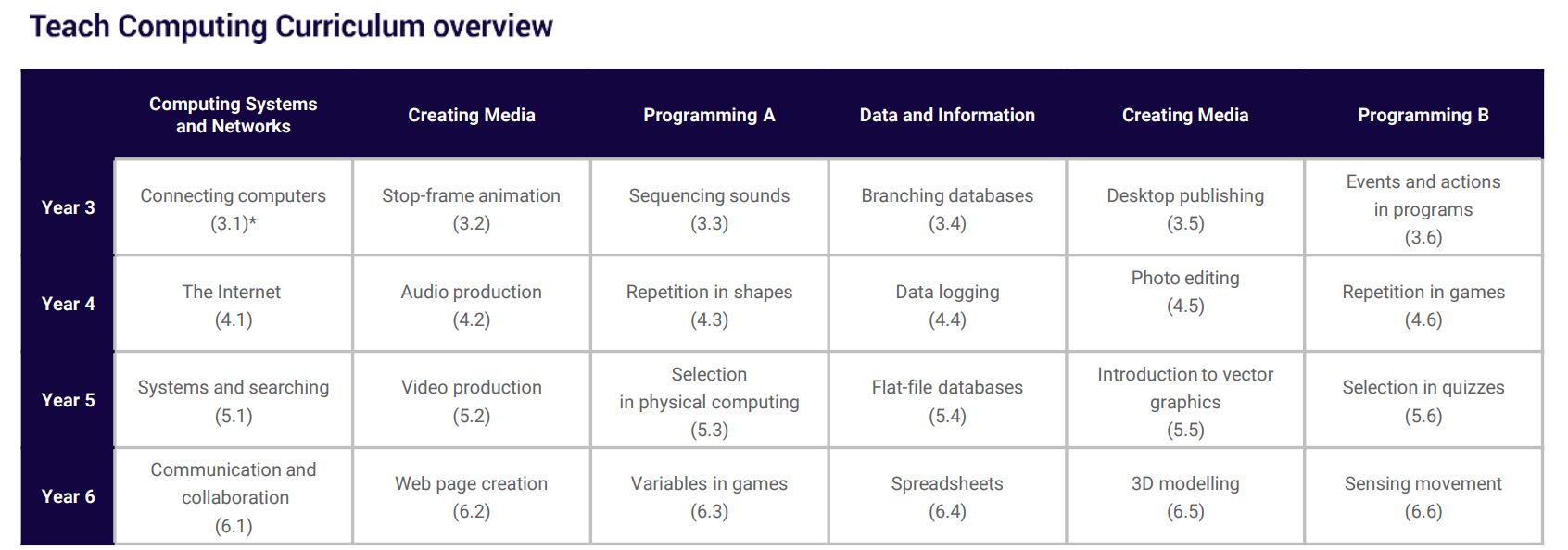
Computing Curriculum Overview KS2
Computing in EYFS
Computing and is very important in the foundation stage to ensure that children enter Year 1 with a strong foundation of knowledge and experience. We live in a technological world and technology is integrated into the lives of young children just as it is our classrooms.
Our Computing scheme for the EYFS is centred around play-based activities that focus on building children’s listening skills, curiosity and creativity and problem solving.
Technology in the Early Years can mean:
- taking a photograph with a camera or tablet
- searching for information on the internet
- playing games on the interactive whiteboard
- exploring an old typewriter or other mechanical toys
- using a Beebot
- watching a video clip
- listening to music
- using a variety of applications on other devices to support all areas of the Early Years Framework.
Allowing children the opportunity to explore technology in this carefree and often child-led way, means that not only will they develop a familiarity with equipment and vocabulary but they will have a strong start in Key Stage 1 Computing and all that it demands